
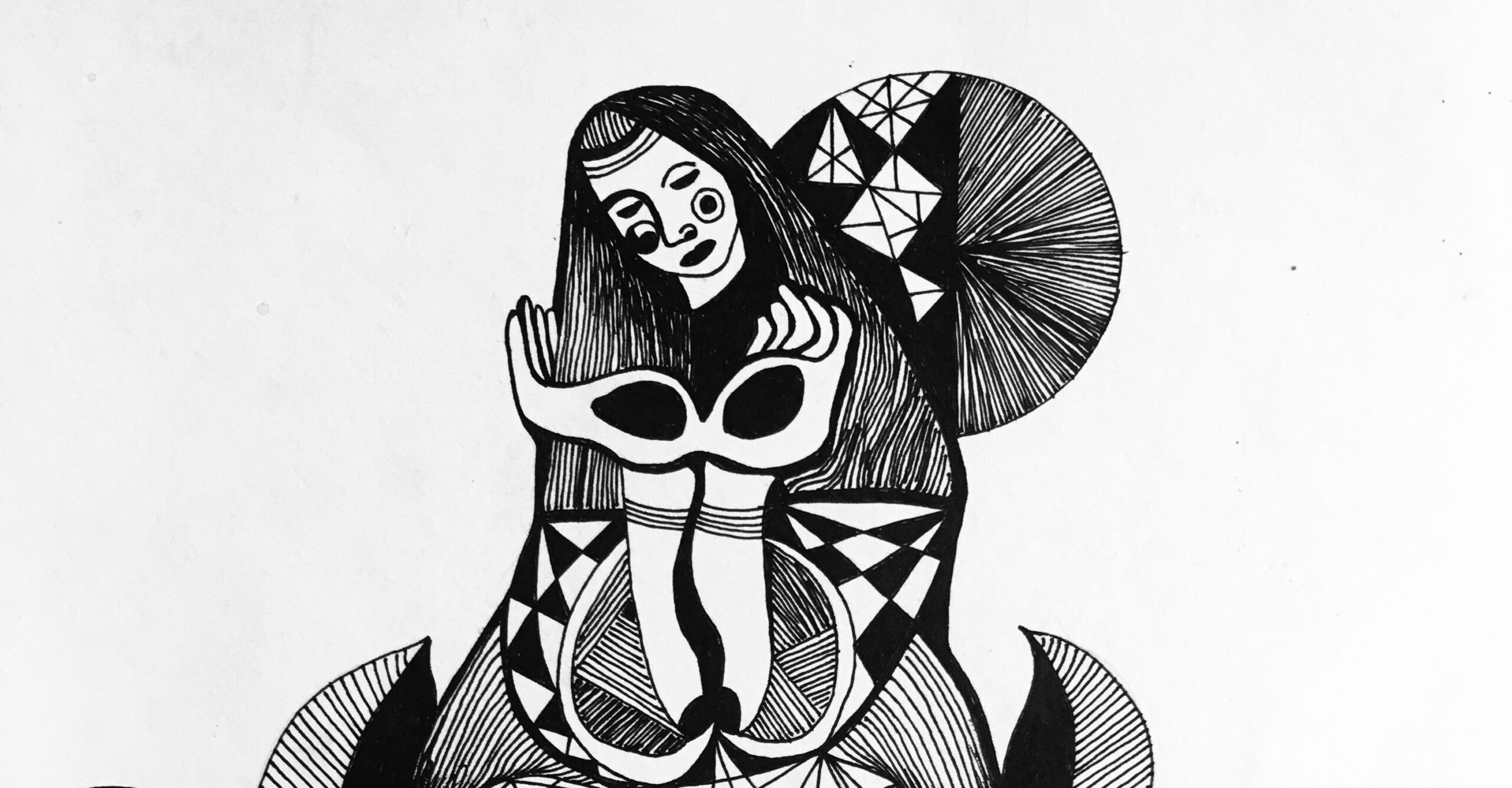
Continuing this issue’s engagement with Indigenous women’s knowledge, ancestral healing, and community-based care, “Emita. Healing Hands, Cleansing Hands: An Unexpected Farewell” reflects on the life and legacy of Ema, a forest healer whose practice was rooted in plant medicine and spiritual ritual. Through poetry, drawings, and narrative by Randy Chung Gonzales and Lucas Nakandacare, the piece documents the relational and experiential dimensions through which healing knowledge is learned and transmitted.
The text reconstructs the relationship between mentor and apprentice, illustrating how Indigenous medical knowledge is sustained through everyday practice, observation, and trust. By recounting Ema’s treatments—such as rituals addressing mal de aire in children—the narrative highlights the spiritual and ecological foundations of healing while honoring the role of women healers as custodians of knowledge often overlooked within dominant biomedical frameworks.
Emita. Healing Hands, Cleansing Hands: An Unexpected Farewell
Summary
This text is an intimate and moving tribute to Ema, a forest healer whose life was dedicated to the ancestral art of healing through plants and spiritual rituals. Narrated from the personal experience of author Randy Chung Gonzales and written by Lucas Nakandacare, the story reconstructs the relationship between mentor and apprentice, marked by the silent transmission of profound knowledge born from the bond with Pachamama and the spirits that inhabit the forest. Through memories, descriptions of traditional cures—such as the treatment of mal de aire in children—and a sensitive and poetic language, the author portrays Ema’s greatness, her humbleness, and her legacy. The text honors the value of Indigenous knowledge and of wise women, guardians of a spiritual medicine often ignored by modernity, and suggests a reflection on the continuity of this knowledge in those who receive it with respect and commitment.
About the authors

Randy Chung Gonzales was born in Peru. Since 2015, when he underwent his deepest initiation, he has dedicated himself to spiritual rituals, leading ceremonies, and taking master plants, deeply devoting himself to the care of those who seek him. He is the author, along with anthropologist Fédérique Apffel-Marglin, of the book Iniciación por los espíritus: tratamiento de las enfermedades de la modernidad a través del chamanismo, los psicodélicos y el poder de lo sagrado (Spirit Initiation: Treating the Diseases of Modernity through Shamanism, Psychedelics, and the Power of the Sacred), in which he narrates his initiation process. He was president of the Sacha Mama association in Lamas, Peru. He founded and directs the Ampikuk vegetalista center in the Peruvian jungle and is present in Brazil every month, leading vegetalista workshops at LIS. He also works as an artist, exploring the relationship between art and spirituality.

Lucas Nakandacare, Brazilian, Psychologist, Postgraduate in Clinical Psychology, Therapeutic Companion, and Integrative Practices Therapist. He has been participating in vegetalista diets since 2014 and was part of the Ritual Practices team at the LIS Vegetalista Center in Areal, RJ (Brazil), alongside Randy Chung and Karla Perdigão.
Read the article and access the complete Special Edition issue.








Leave a Comment