
From the streets of Bolivia to the skateparks of the Navajo Nation, skateboarding has become an unexpected space for Indigenous women’s collective resistance and healing (NPR, 2024; Smithsonian Folklife Festival [SFF], 2024). Here, Indigenous women use movement as a way to challenge colonial control, reclaim their bodies, and land (The Feminist Centre for Racial Justice [FCRJ], 2025). It also functions as embodied healing, a practice that uses movement to process trauma, regulate the nervous system, and reconnect mind, body, and spirit, while fostering collective alignment, community cohesion, and mutual support (National University of Natural Medicine [NUNM], 2025; American Holistic Counseling Center [AHCC], n.d.; First Session, n.d.).
Movement as Medicine
Skateboarding can be understood as a somatic practice in which the body is engaged through intentional, movement-based experiences that foster awareness, balance, and connection. This approach reflects the principles of traditional medicine, which aim to restore harmony among mind, body, spirit, land, and community (AHCC, n.d.). In this way, skateboarding becomes more than recreation; it is an embodied practice that links self, environment, and community (NUNM, 2025).
Contemporary Indigenous and Feminist Skate Movements

Imilla Skate: Cultural Reclamation Through Movement
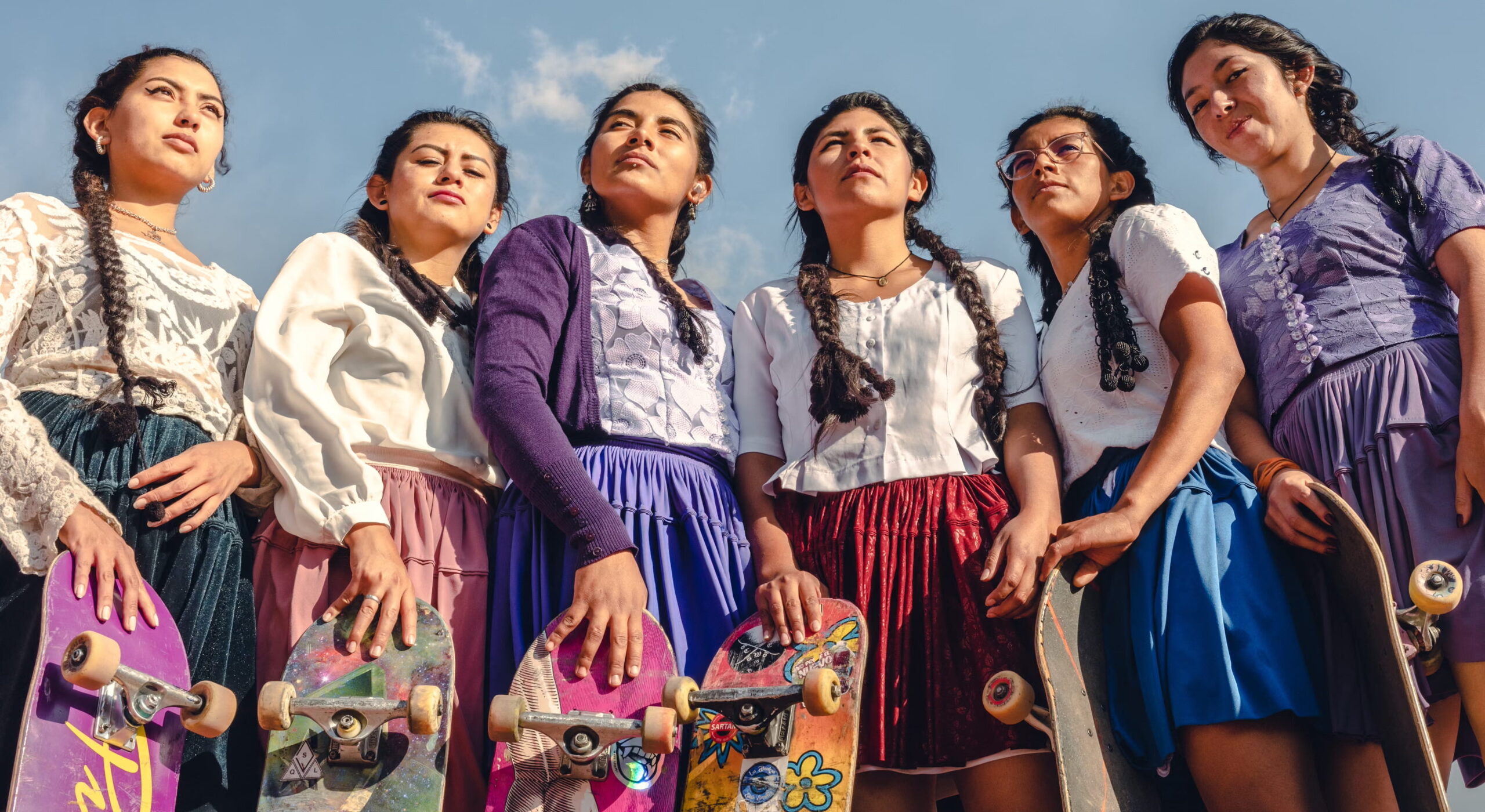
A powerful representation of skateboarding as a healing practice for Indigenous women can be found in the work of Imilla Skate, an all-women Indigenous Bolivian skate collective that integrates cultural reclamation and relational healing through community. The collective was founded in 2019 by Aymara and Quechua women, who skate in their traditional Indigenous skirts, polleras, as a way to reclaim cultural identity and challenge racism, sexism, and other exclusionary forces within both the skateboarding scene and the broader public space (SFF, 2024; NPR, 2024). The women run community skate schools and workshops, mentoring Indigenous women and girls (SFF, 2024).

Skateboarding provides a healing practice as one member describes that when she felt “alone, depressed, or overwhelmed by anxiety,” she rode her skateboard “until she felt better” (NPR, 2024). The collective healing is seen through restorative community building, as one skater states, it “builds community, restores balance,” and through embodied practice is shared intergenerationally (SFF, 2024). Another described how skateboarding builds resilience, sharing that skating “makes me feel capable because I can break my own limits…and get over my daily fear” (The Guardian, 2022). The women share how skating in traditional polleras embodies the principle that “skateboarding doesn’t discriminate… It’s about doing what makes you happy.”Further, the philosophy that “when you fall, you get back up” is a mentality that heals, nurtures resilience, and creates a living metaphor that extends from the skatepark into daily life (SFF, 2024).
Navajo Modern Matriarchs on Boards
Another example comes from the Navajo Nation, where the Modern Matriarch Skate Jam and the Dine Skate Garden Project reveal how skateboarding creates a space for Indigenous women’s wellness (KOAT, 2024). The first-ever all-female Indigenous skateboard competition. The event organizer, Amy Denet Deal, emphasizes that the spaces allow the girls to “express themselves, care for their physical health, and inspire others to participate.” In this way, skateboarding is recognized as both physical and emotional medicine (KOAT, 2024).
Further emphasizing the space, it is described as “a modern matriarch actually supporting our young girls,” highlighting the international care and networks created for Indigenous women. The competition is deeply emotional, with opportunities like these very rare in Native communities, especially women-centered projects (KOAT, 2024). They provided thousands of skateboards and created a women-focused competition, but it’s not a competition in the sense of winning, but really a space for empowerment and health equity. Denet Deal affirmed that “it doesn’t matter whether you win a first prize or just show up, we’re there to celebrate you: (KOAT, 2024). This healing comes through mutual support and by showing up for each other.
Finding Safety and Self-Trust Through Skateboarding
For Navajo artist Naiomi Glasses, skateboarding has been a source of safety, healing, and self-confidence (Glasses, 2023) Her childhood was impacted by being bullied for having a cleft palate, and skateboarding is where she found refuge, describing it as “a safe space where I feel like I can be myself, learning how to be even more confident” (Glasses, 2023).
She found skateboarding as a way to regulate stress and build trust in herself, and allow this practice to extend to a community-based healing resource, as she describes “skateboarding did a lot for my own mental health,” she explains how she now wants to expand access to skateparks on the reservation so that others too can experience the same sense of safety and emotional grounding (Glasses, 2023). Her story demonstrates the deeply healing somatic practice that is more than a recreational hobby, but a form of self-expression and collective healing medicine.
Skateboarding, Motherhood, and Intergenerational Healing
Hailey Allen (Yakama/Umatilla), Indian name Thx, is a mother, artist, researcher, and co-owner of a small skate shop who experiences skateboarding as a source of both joy and healing. The movement helps her quiet internal chatter, reconnect with her body, and enter a meditative state of flow. Through skateboarding, she builds confidence, endurance, and trust in herself, learning to be present and embrace her emotions. This sense of healing and joy is amplified when she shares the experience with her young daughter by celebrating their triumphs, feeling the rhythm of movement, and watching her daughter grow more balanced, present, and proud. Hailey’s skateboard shop features Indigenous artwork, including her own. Bringing new life to old boards, she transforms them into vibrant portraits of Indigenous women, celebrating their strength and beauty.


Flow, Focus, and Embodied Healing
A qualitative study found that young women skaters reported that the focus and “flow” experienced while skateboarding led to calm, present-moment awareness, self-compassion toward their bodies, and a deep sense of well-being (Nottingham Trent University [NTU], 2024). Supporting the role of embodied medicine, skateboarding demonstrates its capacity to function as healing, allowing for immersive focus in which time dissolves, and reaching a space of mindfulness through motion and rhythm builds a concentration that quiets intrusive thoughts and helps anchor women in the present moment (NUNM, 2025). Repetition and practice help skaters develop body trust and cultivate self-compassion, fostering a mindset that is supportive rather than self-critical (NTU, 2024).
Play, Joy, and Resistance to Colonial Norms
Skateboarding as a healing practice centers on play, joy, and non-competitiveness, standing in direct opposition to colonial, patriarchal, and productivity-driven norms (FCRJ, 2025). Healing is individual and relational, grounded in community and shared experience within girl and women-centered skate spaces (KOAT, 2024). From an Indigenous and decolonial feminist perspective, skateboarding affirms bodily autonomy, spatial freedom, and the fundamental right to move in rhythm, syncing mind, body, and spirit, and to nurture community to restore and rebalance the Indigenous female body and to move in joy and connection to community AHCC, n.d.).






Leave a Comment