
The healing capacity of fungi, such as psilocybin mushrooms, and certain plants, such as peyote cactus, is increasingly supported by a growing body of research. For thousands of years, peyote has offered a profound source of spiritual connection and healing. Within ceremonial contexts, it can serve as a gateway and a passage into altered states of consciousness that support reflection, insight, and restoration. And the scientific community has increasingly provided evidence to support the therapeutic efficacy of psilocybin’s healing properties. For millennia, these plants have served as gateways, through altered states of consciousness—a passage— to profound spiritual healing and connection with the sacred. The medicinal significance of psilocybin-containing mushrooms and the peyote cactus is directly linked to a healing, especially in the fields of mental and behavioral health conditions, which explains the centrality of this lineage and its deep medicinal and ceremonial significance for Indigenous peoples across the Americas. It remains crucial that, as it re-emerges in Western clinical research and public discourse, the spiritual and cultural context be respected and not stripped from healing in favor of the rigid medicalization of biomedical systems. This piece explores these healing plants and fungi through an integrated lens, drawing a Indigenous roots and the known psychological and physiological effects, in conjunction with communal ceremony, and on how these medicines can heal and on safeguards to prevent them from being extracted from communities that steward them.
Mushrooms /Psilocybin
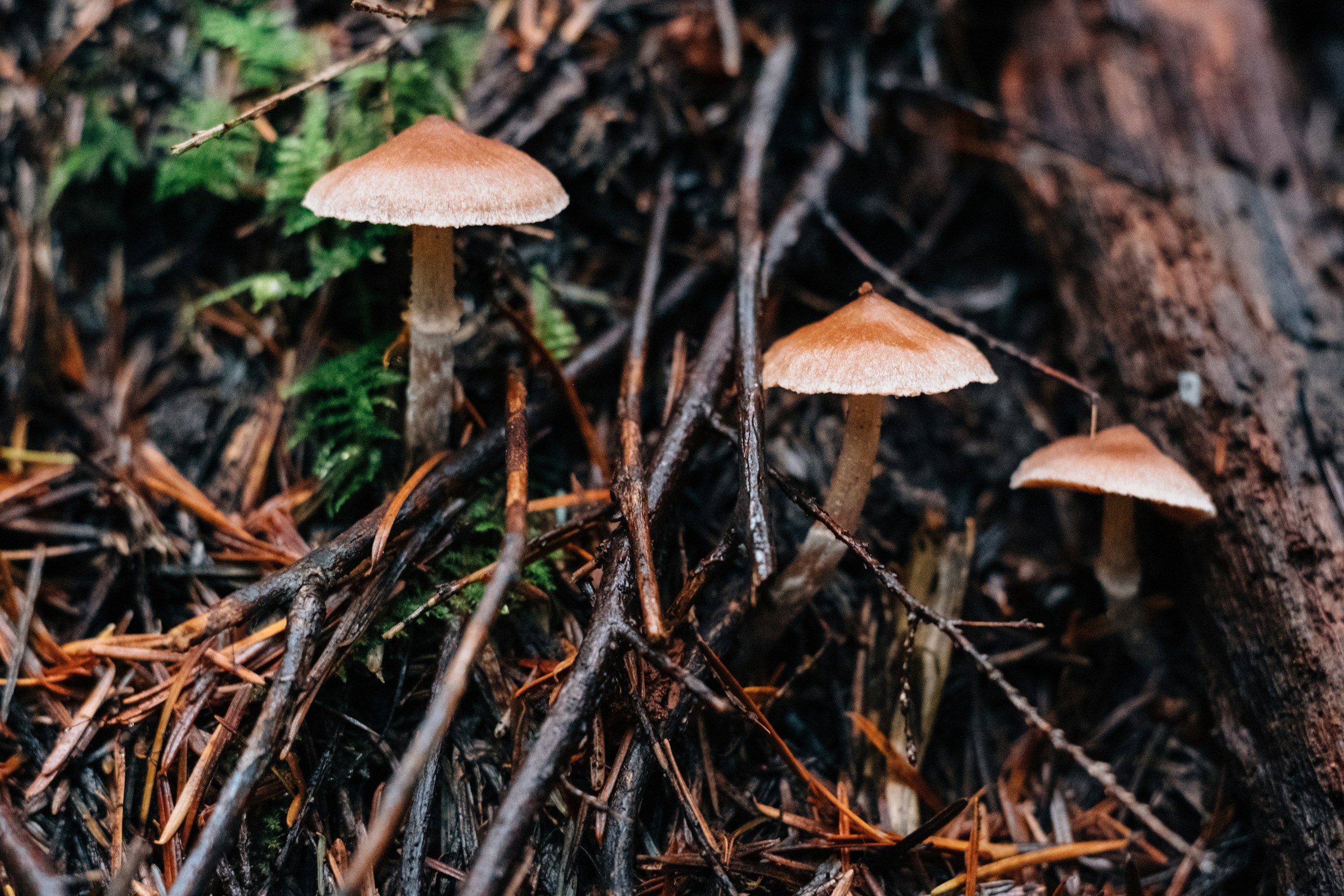
There are hundreds of hallucinogenic mushrooms, including Psilocybe aztecorum, P. Mexicana, and P. caerulescans as well as Panaeolus sphinctrinus ,P. foenisecii , and Stropharia cubensis (Spinella, 2001). Also known as mush ooms,magic mushrooms, shrooms, and boomers, psilocybin mushrooms are found growing throughout the world, particularly in Mexico and Central America, where Psilocybe aztecorum and P. mexicana are used in religious ceremonies by the Aztec, Mazatec, Chinantec, Mije, Zapotec, Mixtec, and Mayan peoples (Spinella, 2001).
Most psychoactive mushrooms contain psilocybin (4-phosphoryl-DMT) or psilocin (4-hydroxy DMT), the two primary hallucinogenic alkaloids, as well as the less common baeocystin (Erowid, 2009; Spinella, 2001). Compared to LSD, psilocybe mushrooms are less potent and shorter-acting, and they provide a gentler “trip”. Both psilocybin and psilocin act on the serotonergic system, like LSD. The effects of psilocybe mushrooms begin 30 to 60 minutes after ingestion and last from 4 to 6 hours.
Psilocybin’s Effects on Psychological and Physiological Health
Psychologist Timothy Leary conducted early research on psilocybin in 1961. He used psilocybin to treat prisoners in Concord, Massachusetts, theorizing that the altered states engendered by the drug would lead to reduced levels of recidivism among the prisoners (Leary et al., 1965). An 18-month follow-up study showed that the prisoners’ recidivism rate was 23%—much lower than the expected 65% (Forcier & Doblin, 1992).
Psilocybin use is associated with profound spiritual experiences that have lasting effects (Griffi ths, Richards, McCann, & Jesse, 2006). The psychological effects of psilocybin include shifts in mood, perception (visual), and perceived changes in time and space (Hasler, Grimberg, Benz, Huber, & Vollenweider, 2004) as well as loosening of ego-boundaries and geometric and complex visual hallucinations.
A client living with long-term physical injuries once shared a powerful insight after a psilocybin experience. As adapted from Dr. Leslie Korn’s work, he described the moment like this:
“I could see the molecules of everything—vibrating, shimmering, alive. I was witnessing the miracle of life, and I realized I shouldn’t squander what I have.”
People who use subhallucinogenic doses of psilocybin or LSD to prevent or treat cluster headaches report efficacy, with only a single dose required for remission (Sewell, Halpern, & Pope, 2006). The authors suggest there might be mechanisms at work that are unrelated to the psychoactive components of psilocybin and LSD (Sewell et al., 2006).
Griffiths, Johnson, Richards, McCann, and Richards (2008) found no adverse effects from a clinical trial of psilocybin in a14-month follow-up study;however, they advised of some potential risks, including panic and fear, exacerbation of psychiatric conditions, and long-lasting alterations of perception. Hasler et al. (2004) concluded that psilocybin given to healthy subjects is safe but advised against the use of psilocybin for those with cardiovascular conditions or hypertension.
Peyote
“Peyote is the crossing of the souls, it is everything that is. Without peyote nothingwould exist.”—A Wixaritari man (quoted in Anderson, 1996, p. 15)
Peyote (Lophophora williamsii ) is a cactus that grows in the deserts of Central Mexico and as far north as Texas (Rätsch, 1998). Péyotl , the Nahua word, means “furry thing” (Ott, 1995), referring to the tops of the cactuses. The fresh or dried heads of the cactus, called “peyote buttons,” are eaten or made into a tea or a powder (Rätsch, 1998). Peyote preparations are bitter-tasting and dosages vary greatly (Rätsch, 1998). Common names include dry whiskey, divine herb, medicine of god, péyotl, and híkuri. The major active ingredient is mescaline (3,4,5-trimethoxy-.-phenethylamine).
Archaeological digs in Texas have discovered peyote buttons as old as 6,000 years (Rätsch, 1998). The Cora, Rarámuri, Wixárikas, Tepecanos, and other communities use peyote in religious rituals around which agricultural seasons and spiritual life is organized. The wixárikas, use peyote, which they call híkuri, for medicinal purposes—as a salve for pain, for scorpion stings, and to receive messages from the gods (Anderson, 1996). Every October the Wixárikas make a pilgrimage to the sacred land of Wirikuta, where the peyote grows. A successful journey will ensure abundant crops and good fortune (Anderson, 1996). The Cora (they refer to themselves as Nayari) of western Mexico use peyote to battle fatigue during all-night dancing ceremonies (Anderson, 1996). The Rarámuri traditionally drink a peyote mixture to promote health and longevity, and they chew peyote into a paste to be used topically for various ailments such as snakebites, wounds, burns, rheumatism, and fractures (Anderson, 1996).
Peyote is used traditionally in Mexico to reduce fevers, for back pains, and to promote lactation (Anderson, 1996). Peyote use was banned during Spanish colonization and was severely punished by the Inquisition (Rätsch, 1998). However, the practices merely went underground; most of the communities live in high mountainous regions that are difficult to reach or control.
The influence of Christianity was absorbed into many of the indigenous communities’ rituals. Over the past 40 years a new wave of community trauma has affected most of these indigenous communities; forced relocation to access land for drilling and mining, commodification, and sales of spiritual artwork arising out of the peyote visions have been necessitated by increased poverty and the demands of “spiritual tourism.”
The use of peyote was spread to Native Americans by the Mescalero Apache and the Lipan Apache of Mexico (Rätsch, 1998). Native Americans use peyote to dispel bad spirits that are believed to be causing illness and also to treat diabetes, pain, colds, bites, alcoholism, headache, blindness, menstrual disorders,and broken bones (Anderson, 1996).
The Native American Church (NAC) is a formally organized pan-Indian religion diffused directly from the older Mexican forms that transcends current borders. The NAC is based on the use of the peyote cactus as a sacramental medicine, which developed in the late 19th century in response to the trauma resulting from conquest of Native American communities (Calabrese, 2007). Membership in the NAC requires abstinence from alcohol and drugs and offers an important resource to participants who are detoxifying from alcohol. The use of peyote is part of a holistic communal ceremony during which the peyote spirit may illuminate an answer or knowledge about one’s problems. As in the case of many psychoactive drugs used in the context of communal ritual with a supportive set and setting, participants undergo initiation with a guide who supports their vision of a fulfilling life without alcohol (Pascarosa & Futterman, 1976).
The NAC provides an indigenous alternative to Alcoholics Anonymous (AA), fostering positive cultural practices that support individual and group identity that also mitigate the ongoing effects of colonization and promote health in areas beyond addiction (Prue, 2008). However, AA does not approve of the NAC’s use of peyote (Prue, 2008). Halpern, Sherwood, Hudson, Yurgelun-Todd, and Pope (2005) conducted a trial with three groups of Navajo tribe members, one group that used peyote regularly, one group with past alcoholism, and one group with minimal substance use. The study consisted of a screening interview, the Rand Mental Health Inventory, and tests for cognitive and neuropsychological functions. The authors concluded that peyote use did not result in decreased psychological or cognitive function when American Indians were using it in a religious context.
There are more than 55 alkaloids in peyote, including mescaline, the main psychoactive alkaloid (Anderson, 1996). Peyote’s psychoactive effects begin within 45 minutes to 2 hours following ingestion and last for about 6 to 9 hours (Rätsch, 1998). The peyote experience is similar to the visionary experiences facilitated by LSD and psilocybin. Before the initial effects begin, nausea and vomiting are common (Rätsch, 1998). The first phase, which lasts about 3 to 4 hours, is usually very uncomfortable, with effects such as headache, nausea, vomiting, a choking feeling, urgency to urinate, stomach cramps, tremors, anxiety, and fear (Anderson, 1996). The second phase is much more pleasant and includes feelings of euphoria, visions, and distortions in sense perception, as well as somatic effects. The use of peyote was made legal for church members in the United States in 1994.
Through the Indigenous framework of being in relation, reciprocity, and responsibility, the powerful psychoactive medicines support profound insights, spiritual connection, and a significant relief from suffering and pain. Indigenous traditions have protected these medicines for thousands of years, and they represent more than a psychedelic drug for recreational purposes or a mechanism purely for the administration of treatment. These negative connotations in the public discourse create institutional barriers and stigma that hinder the ceremonial and sacred uses. Not only that, but it also disrespects medicine and community-based healing practices, negating the model’s ethical frameworks and ceremonial protocols, which stand in contrast to the purely biomedical approach. As interest in psychedelics has grown in clinical settings, it’s essential to center Indigenous knowledge, defend land and access to these medicines, and honor the sacred dimensions of the ceremonial use, to prevent renewed extractivism and protect healing that is grounded in respect and cultural integrity, and support the ongoing process of decolonization.
Portions of this blog were adapted from Dr. Leslie Korn’s Rhythms of Recovery: Trauma, Nature, and the Body.







Leave a Comment