

Plants that function as nervines are defined by their action on the nervous system. They may relax and aid in sleep or reduce pain. They may, like chamomile, soften digestive distress or lift mood, like St.John’s wort. Here, we explore a curated selection of the most effective nervines and the wide range of ways they support nervous system health.
Kava
Kava (Piper methysticum) is a South Pacific island plant of the pepper family (Piperaceae) used for both ceremony and medicine. Kava has many folk names, including agona, ava-ava, kava-kava, kawa pepper, yagona, and the name awa or kava, a Polynesian word meaning “bitter” (Rätsch, 1998).
It is traditionally used for its relaxing effects, which co-occur with mental alertness. Kava is one of the most effective botanical anxiolytics and it should be the first choice for people who would otherwise choose a benzodiazepine. Kava contains compounds called kavalactones, or kavapyrones, which are responsible for most of kava’s pharmacological effects, including increased mental relaxation without sedation, muscle relaxation, and analgesia. The mechanisms include modulation of GABA receptors, voltage-gated ion channels, and monoamine oxidase inhibition. Additionally, it has been shown to improve sleep quality by enhancing the duration of deep sleep and increasing sleep spindle activity. It also improves recognition memory and leads to an improved accuracy and performance on visual attention and working memory activities (Bian et al., 2020). Additionally, kava’s bioactive compounds, including kavalactones and flavokavains, demonstrate anti-inflammatory activity through the inhibition of pro-inflammatory mediators and the regulation of inflammatory signaling pathways. More studies have also revealed the anticancer and chemopreventive potential through epidemiological associations with reduced cancer incidence and experimental evidence of reduced DNA damage, suppression of tumor growth, and inhibition of cancer cell proliferation (Bian et al., 2020).
Some of the challenges faced by Kava include the diversity of products and a lack of standardization, as well as inconsistent chemical compositions, which complicate efficacy and safety. Also, in rare cases, it has been linked to hepatotoxicity, but often when connected to specific kava preparations that are non-traditional forms (Bian et al., 2020). Kava is contraindicated in people taking benzodiazepines or antipsychotic drugs. It is also contraindicated in patients with Parkinson’s disease. Kava should be discontinued at least 24 hours before surgery because of its possible interaction with anesthetics.
The Three Sisters: Hops, Valerian, and Passionflower
Hops
The first sister of three, hops (Humulus lupulus), is one of the two genera in the Cannabaceae family, along with marijuana (Cannabis sativa). Hops buds are used as a bitter in the brewing of beer, a bitter tonic medicine, and a sedative. Hops buds contain the resinous lupulin. They are rich in flavonoids and have been used as an antibiotic, antifungal, and antioxidant as well as a pain reliever. Hops is approved by the Complete German Commission E Monographs to treat anxiety, restlessness, and sleep disturbances (Blumenthal, 1998). Hops (and the B vitamins) found in a good quality dark beer make 4 to 6 ounces of beer an excellent quick remedy for muscle cramps, an anxiety or panic attack, or insomnia due to pain. Hops is available as a liquid extract. The use of hops in large amounts should be monitored for potential estrogenic effects; for the same reason, hops can be useful for menopausal symptoms associated with low estrogen.
Valerian
Sister two is valerian (Valeriana officinalis L.), known for its sedative effects on the nervous system. Valerian is also called hierba de los gatos (“The cats’ herb”) in Mexico because cats react to it as they do to catnip in spite of its repugnant smell to most humans. Traditionally, valerian was an incense used in Europe to protect against evil (Rätsch, 1998).
Valerian acts as a partial agonist at the 5-hydroxytryptamine 2A receptor, which may increase melatonin levels, thereby improving sleep (Tammadon, Nobahar, Hydarinia-Naieni, Ebrahimian, Ghorbani, & Vafaei, 2021). It contains valerenic acid, which binds at the GABA-benzodiazepine receptors (Houghton, 1997), complementing the sleep-regulating effects with relaxation and sedation. Other pharmacological activities include effects on the serotonin, noradrenaline, and dopamine systems.
One study found it was as effective as oxazepam for sleep, and others showed improvements in children’s mental health and sleep issues for cancer patients. Another study examined patients with insomnia who were successfully withdrawn from benzodiazepines by using valerian (Poyares, Guilleminault, Ohayon, & Tufik, 2002). Valerian effectively reduces anxiety and restlessness and promotes sleep (Donath et al., 2000; Muller, Pfeil, & von den Driesch, 2004). It has also been shown to be as effective as benzodiazepines in several studies (Schmitz & Jackel, 1998; Ziegler, Ploch, Miettinen-Baumann, & Collet, 2002).
Although study results have not always been consistent, some studies found no clear benefits over a placebo to treat insomnia (Tammadon et al., 2021). In addition, the use of valerian is contraindicated with the use of other central nervous system depressants, such as alcohol (Spinella, 2004).
| Herb | Primary Action | Best For | Key Mechanism |
| Kava | Relaxant, Anxiolytic, Anti-inflammatory, Anticancer | Anxiety, Stress, Inflammation, Cancer Prevention | Calms GABA receptors, reduces inflammation, supports antioxidant defense, slows cell growth, promotes cell cleanup |
| Valerian | Used to induce sleep and improve sleep quality. | Insomnia and sleep disturbances, especially difficulties in initiating or maintaining sleep | Components inhibit the breakdown of gamma-aminobutyric acid (GABA) in the brain, leading to sedation and decreased central nervous system activity. |
| Passionflower | Anxiolytic, Sedative | Anxiety, Insomnia, Stress, Depression | Modulation of GABA system, affinity to GABAA and GABAB receptors, inhibition of GABA uptake |
| Skullcap | Mild sedative, relaxant, anxiolytic, antioxidant, anti-tumor, and neuroprotective effects. | Treating anxiety, insomnia, promoting healthy menstrual cycle, anti-cancer activity, and neuroprotection | Presence of flavonoids (baicalin, baicalein, wogonin), GABA modulation, antioxidant capacity, and phytomelatonin content |
| St. John’s Wort | Anti-depressive and anxiolytic, and anti-inflammatory properties | Depression, emotional/behavioral complications in children, obsessive-compulsive disorder (OCD), premenstrual syndrome (PMS), psoriasis | Boosts serotonin, dopamine, norepinephrine; affects liver enzymes; inhibits MAO; modulates GABA |
Passionflower
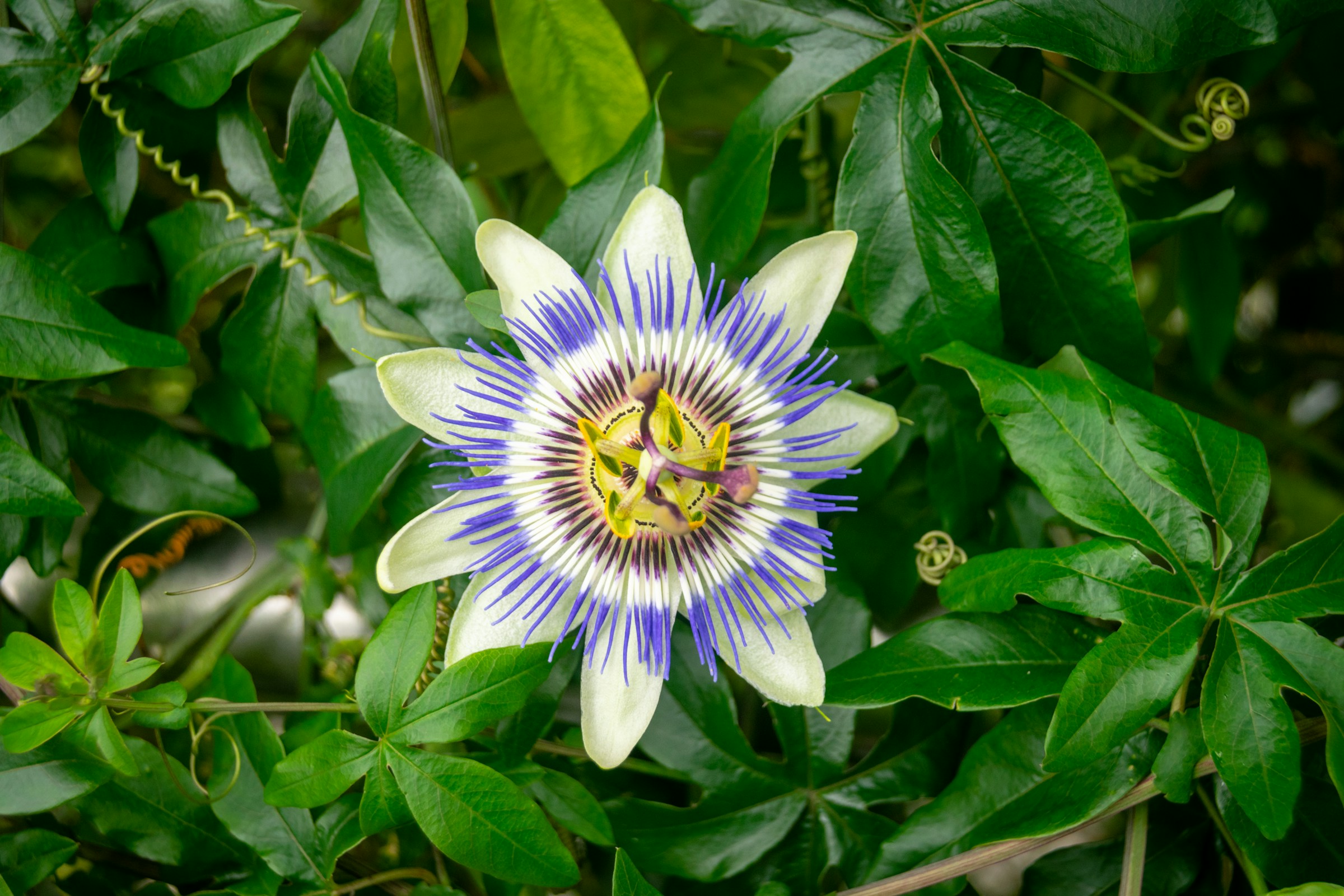
Passionflower (Passiflora incarnata L., P. coerulea, and P. edulis), the third sister, is a tropical vine plant indigenous to Central and South America. It produces a delicious fruit rich in vitamin C. Passionflower was given its New World name by the Spanish after their arrival in Mexico in the 15th century. They likened the corona to the Christian crown of thorns, the five sepals, and five petals to the 10 apostles, and other parts to the nails and wounds of Christ. Apparently they also experienced at first hand its capacity to alleviate suffering. The leaves are traditionally used as a sedative and anxiolytic. Some species have entheogenic seeds. Studies demonstrate efficacy for generalized anxiety disorder (Spinella, 2004), for sleep, and for reducing anxiety without sedation prior to surgery (Movagegh, Alizadeh, Hajimohamadi, Esfehani, & Nejatfar, 2008). Passiflora incarnata contains chrysin, a natural flavone that has anxiolytic effects equal to those of benzodiazepines (Brown, Hurd, McCall, & Ceremuga, 2007). Master herbalist Ed Smith recommends a combination of equal parts passionflower (Passiflora incarnata and edulis), valerian (Valeriana officinalis), hops (Humulus lupulus), chamomile (Matricaria chamomilla), and catnip (Nepeta cataria) as a sedative for the treatment of nervousness, depression, and insomnia (Smith, 2003).
Skullcap
Skullcap (Scutellaria lateriflora) is a member of the mint family (Lamiaceae). The name skullcap describes the shape of the calyx at the base of the flowers, which resembles a miniature medieval helmet.During the 19th century, the common name used in America was “mad dog” (Joshee, Patrick, Mentreddy, & Yaday, 2002), so named for its treatment of rabies due to “mad dog” bites.
Among Native Americans, it has been used as an herbal medicine for over 200 years Among the Cherokee, the plant was used in infusions and decoctions for breast pain and menstrual health, and the Iroquois used the roots to prevent smallpox and treat throat irritations (Sherman & Joshee, 2022).
Skullcap acts on benzodiazepine receptors (Medina, et al., 1997). It is a gentle and effective anxiolytic and sedative and can be used over a long period of time without concern. It is anti-inflammatory, and it strengthens vitality. Skullcap is beneficial for insomnia, anxiety, and headaches. Traditionally, Native Americans used it to treat various conditions, including anxiety, insomnia, breast pain, and to expel afterbirth. Also used as a strong emmenagogue, it promoted a healthy menstrual cycle and stimulated the reproductive system postpartum. Other uses include treatment for fever, chills, diarrhea, sore throats, eye pain, kidney and nerve issues, and heart conditions. Also, historically referenced as a mild sedative or relaxant (Sherman & Joshee, 2022).
Past reports of hepatotoxicity were linked to the ingestion of adulterated hepatotoxic plants, such as germander (Teucrium canadense and Tchamaedrys), which has a morphologically similar structure to skullcap, or to its being mixed in with its products, emphasizing the importance of proper identification and quality control (Sherman & Joshee, 2022). Skullcap should not be used during pregnancy.
St. John’s Wort
St. John’s wort (Hypericum perforatum) is a herbaceous plant with yellow flowers. It is the leading antidepressant used in Germany (Robbers & Tyler, 1999). The clinical indications for St. John’s wort extract listed in the official German Commission E monograph include depression, fear, and nervousness. A Cochrane Review of 29 studies in 5,489 patients with mild to moderate depression compared treatments of St. John’s wort extract with placebo or pharmaceutical antidepressants, demonstrating efficacy and fewer side effects for St.John’s wort.
Nervines offer a valuable, relatively accessible, and affordable option for botanical support for the nervous system, providing calming, mood-modulating, and neuroprotective effects. It can complement or replace Western pharmaceutical typical treatment, such as benzodiazepines, as the typical mode of treatment for conditions related to anxiety. In addition, increasingly supported by evidence, the sleeping and neuroprotective qualities also indicate that these nervines produce an efficacious response, although these results depend on factors such as preparation, individual response, and their traditional use. Safe and effective use requires attention to quality and contraindications.
Portions of this blog were adapted from Dr. Leslie Korn’s Rhythms of Recovery: Trauma, Nature, and the Body










Leave a Comment